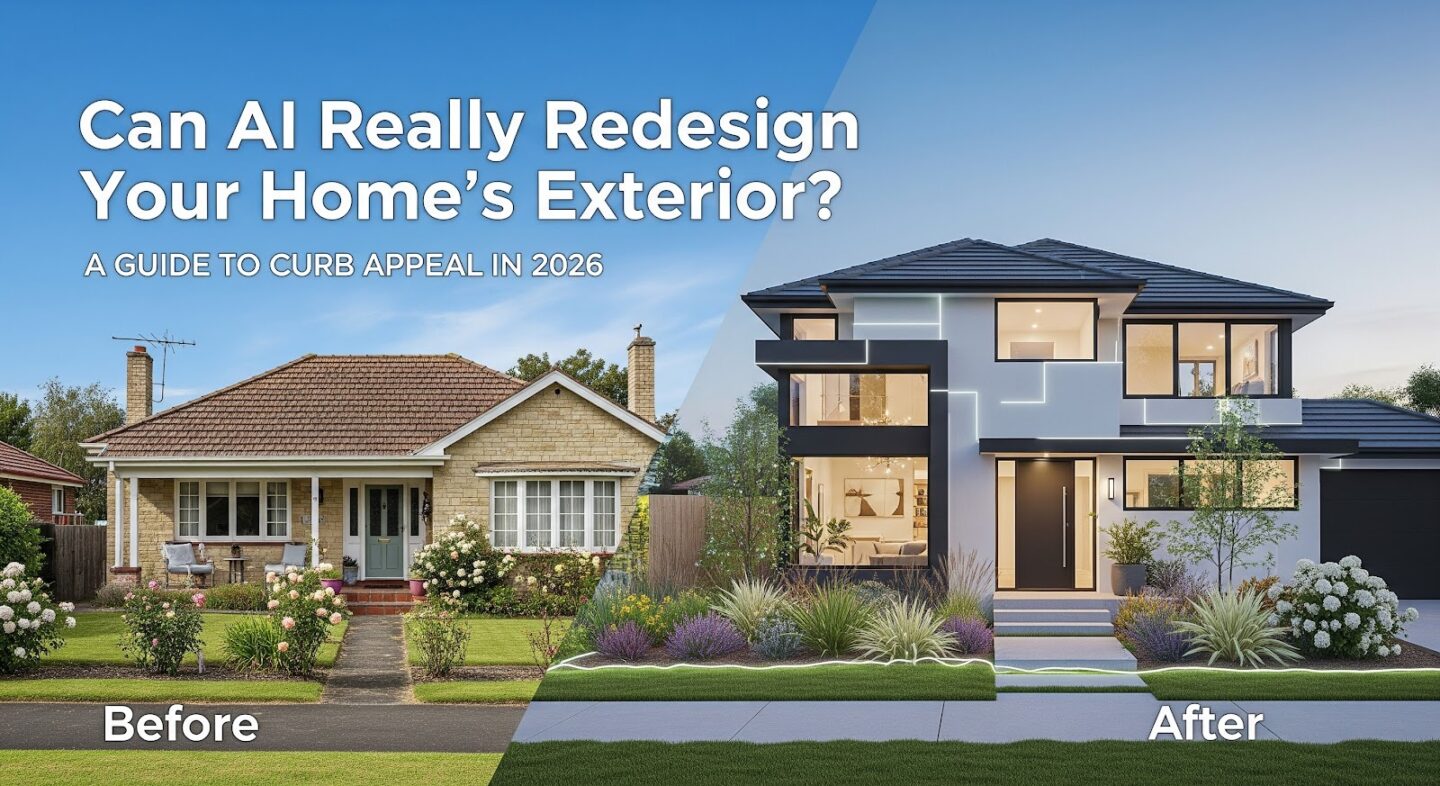
Can AI really redesign your home’s exterior? We spend hours agonising over the shade of “Wevet” or “Ammonite” for our living room walls. It’s a rite of passage for any homeowner. But when it comes to the outside of our homes-the part everyone sees-we often freeze.
Why? because the stakes are infinitely higher.
If you hate the colour of your hallway, a weekend and a tin of paint can fix it. But if you decide to render your brick house in white and hate it? Or if you install grey anthracite windows that clash with your roof tiles? That is a mistake that costs thousands of pounds to rectify.
For years, the only way to avoid this “curb appeal anxiety” was to pay an architect or a 3D visualizer hundreds (sometimes thousands) of pounds for a single static image. But in 2026, the game has changed. Generative AI has moved beyond writing emails and making funny memes-it’s now a legitimate tool for home renovation.
This guide explores how technology is democratizing design, allowing you to see the future of your home before you lay a single brick.
Why Does ‘Curb Appeal’ Anxiety Stop Us from Renovating?
Have you ever walked past a house in your neighbourhood that’s being renovated and thought, “Oh, brave choice”? That phrase is the homeowner’s nightmare.
We crave change. We want that “Pinterest-perfect” facade-perhaps a mix of cedar cladding and crisp white render, or a modern industrial update to a tired 1970s semi. But the gap between imagining it and committing to it is filled with fear.
According to recent industry surveys, over 30% of homeowners delay exterior renovations simply because they cannot visualize the end result. It’s not about the money; it’s about the uncertainty. Traditional swatch cards are useless against the scale of a building. A one-inch square of paint looks entirely different when plastered across a two-storey elevation under the British grey sky.
This paralysis leads to “safe” choices. We stick with what we know, and our homes remain stuck in the past. But what if you could test that “brave choice” risk-free?
What Exactly Is AI Exterior House Design and How Does It Work?
At its core, this technology uses “Image-to-Image” processing. Unlike older CAD (Computer-Aided Design) software that required you to build a house from scratch using lines and polygons, AI works with pixels and context.
You upload a photo of your current house. The AI analyzes the structure-identifying windows, doors, rooflines, and sky. Then, based on your text prompt (e.g., “Modern farmhouse style, white render, timber porch”), it reimagines the image. It keeps the structural integrity of your home but “repaints” the materials and style.
This is where specialized tools for AI exterior house design come in handy. Unlike generic AI art generators that might accidentally add a chimney where a window should be, purpose-built tools are trained on architecture. They understand that a door needs a handle and that roof tiles have texture.
The goal isn’t to replace your builder or architect. The goal is to give you a “visual vocabulary.” It allows you to show your contractor a photorealistic image and say, “I want this,” rather than waving your hands around and hoping they understand what you mean by “modern but rustic.”
Why Is ‘Curb Appeal’ Suddenly So Important for UK Homeowners?
It’s not just about vanity; it’s about value. In the current property market, first impressions are digital. Buyers swipe through Rightmove or Zoopla at lightning speed. If the main photo-the exterior shot-doesn’t grab them, they never see your beautiful kitchen renovation.
Is It Just About Resale Value?
Not entirely. Since the shift to hybrid working, we spend more time at home, but also more time looking at our homes. The “don’t move, improve” movement has seen a massive spike in exterior facelifts.
What is the ‘Halo Effect’?
Real estate agents often talk about the halo effect. A freshly painted front door, tidy pointing, and modern lighting suggest that the inside is well-maintained, too. Conversely, peeling paint and a mossy roof scream “maintenance issues” before a buyer even steps inside.
Which Tools Are Actually Worth Your Time? (The Comparison)
If you Google “home design software,” you will be bombarded with options. But they are not all created equal. Let’s look at the three main categories to see what fits the average homeowner’s needs.
Is Hover Best for Contractors or Homeowners?
Hover is a powerful tool, but it is technically a measurement app.
- The Good: It creates an incredibly accurate 3D model of your home. Contractors love it because it tells them exactly how much siding or paint they need.
- The Bad: You usually need to take about 8 to 10 photos walking around your entire house to generate the model. It’s slow.
- The Verdict: It’s a construction tool, not a creativity tool. If you want to dream up new ideas quickly, it feels a bit like using Excel to paint a picture.
Does Planner 5D Require Design Skills?
Planner 5D is a giant in the interior design world.
- The Good: It allows for granular detail. You can build anything.
- The Bad: You literally have to build it. You start with floor plans. Unless you enjoy spending your evenings learning drag-and-drop CAD interfaces, the learning curve is steep.
- The Verdict: Great for professionals or serious hobbyists who want to design a house from scratch, but overkill for a visual makeover of an existing property.
How Does Paintit.ai Balance Simplicity and Control?
Paintit.ai takes a different approach, focusing on what we call the “EIS” principles: Empathy, Intuitiveness, and Seamlessness.
- The Good: It’s designed for the “blank page” problem. You upload one photo, type a prompt (or choose a style), and get results in seconds. It uses “Automatic model selection,” meaning the system chooses the best AI engine for your specific task without you needing to be a tech wizard.
- The Unique Feature: It doesn’t just give you a pretty picture; it connects the vision to reality with real furniture and material recommendations.
- The Verdict: It’s the “Apple” approach-simple on the surface, powerful underneath. It’s ideal for homeowners who want to iterate through 20 ideas in 20 minutes.
How Do You Go from a Phone Photo to a Dream Home? (Step-by-Step)
Using AI for design is easy, but getting a result that looks real requires a few tricks. Here is the workflow I recommend.
How Should You Take the Source Photo?
Garbage in, garbage out. If you upload a blurry, dark photo, the AI will struggle.
- Lighting: Take the photo on an overcast day. Bright sunlight creates harsh shadows (e.g., under the porch) that can confuse the AI. Flat light is best.
- Angle: Stand straight on. Avoid extreme wide-angle lenses that warp the edges of the house.
- Obstructions: Try to avoid having a large van or a bin lorry parked right in front of the house. While tools like Paintit.ai have “Targeted refinements” to remove objects, it’s easier to start with a clean shot.
What Prompts Work Best for Exteriors?
You don’t need to be a prompt engineer. Speak like a human.
- Bad Prompt: “Nice house.”
- Good Prompt: “Exterior of a semi-detached house, white K-rend render, anthracite grey window frames, cedar wood cladding on the porch, golden hour lighting, photorealistic.”
- Pro Tip: Be specific about materials. Instead of “wood,” say “oak timber” or “cedar slats.” Instead of “stone,” say “Cotswold stone” or “grey slate.”
How Do You Refine the Details without Starting Over?
This is where the “One continuous screen” philosophy matters. In the past, if you generated an image and liked the roof but hated the door, you had to start again. Modern tools allow for In-painting. You can highlight just the front door and type “Solid oak door with brass knocker.” The AI changes only that area, leaving the rest of your perfect design untouched. This allows you to polish the design piece by piece.
What Exterior Styles Are Trending in the UK for 2026?
So you have the tool-now, what do you design? Here are the trends dominating the British landscape this year.
Is ‘Modern Farmhouse’ Still Popular?
Absolutely, but it’s evolving. The classic “white farmhouse with black windows” is softening.
- The Update: We are seeing “Greige” (grey-beige) renders replacing stark white. The black windows are being swapped for “Agate Grey” or distinct olive greens for a softer, more organic look.
- Why it works: It suits both rural cottages and 1990s housing estates. It cleans up messy brickwork instantly.
Can You Mix Traditional Brick with Modern Cladding?
The “Hybrid” facade is huge for 2026. Many people love their red brick but want to modernize it.
- The Look: Keeping the ground floor brick (for durability and mud-splash resistance) and rendering or cladding the top floor.
- The Benefit: It breaks up the vertical mass of the house, making it look wider and more substantial. AI is perfect for testing where the “split line” should be.
How Are Sustainable Materials Changing Facades?
Sustainability is no longer just about insulation; it’s an aesthetic.
- Living Walls: Vertical gardens are moving from office blocks to residential porches.
- Composite Cladding: Looking like wood but made of recycled plastics. It doesn’t fade or rot.
- Solar Tiles: Visualizing a roof with integrated solar (Tesla-style) rather than bolted-on panels is a common request on design platforms now.
What About the Details? (Landscaping & Lighting)
A house doesn’t float in a white void. The “curb appeal” comes from the whole package.
How Can You Visualize Your Garden at Night?
Lighting makes or breaks a home’s evening aesthetic. Use your AI tool to change the time of day to “dusk” or “night.”
- What to look for: Up-lighting on trees, warm light spilling from the windows, and down-lights on the soffits. This helps you plan where to run cables before you render the walls.
Does the Driveway Match the House?
I’ve seen stunning modern houses ruined by a cracked concrete driveway.
- The Test: Use the “replace object” feature to swap concrete for resin-bound gravel, block paving, or even simple loose slate.
- Colour Theory: If your house is a cool grey, a warm gravel driveway can add necessary balance. If your house is warm brick, a cool grey slate drive adds contrast. Visualizing this interplay is crucial.
What Are the Financial Risks of Renovating Without Visualizing?
Let’s talk money. Why is a £6.99 or £24.99 subscription to a design tool a good investment compared to the cost of renovation?
How Much Does a Wrong Decision Cost?
- Re-rendering a house: £3,000 – £8,000+.
- New Windows: £500 – £1,500 per window.
- Cladding: £100 per square metre.
If you install white cladding and realize two weeks later that it gets dirty instantly and looks “cheap” next to your neighbour’s stone wall, you are stuck with it. The cost of “undoing” a renovation is often higher than the renovation itself because of the demolition involved.
Can AI Replace an Architect?
No. And it shouldn’t. An architect ensures your house stands up, meets building regulations, and is insulated correctly. AI replaces the “sketch on a napkin.” It replaces the vague conversations. It allows you to go to an architect and say, “This is the aesthetic I want,” saving them hours of concept work (and saving you billable hours). It bridges the communication gap.
FAQ: Frequently Asked Questions About Virtual Exterior Design
Q: Can I use these AI images for planning permission applications? A: Generally, no. Planning departments require scaled technical drawings (elevations). However, attaching a realistic AI render alongside your technical drawings can help planning officers (and neighbours) visualize that your proposal isn’t an eyesore. It helps with the “persuasion” part of planning.
Q: Does it work on terraced houses? A: Yes, but be careful. Context is key. You can use the “edit” tools to ensure you aren’t visualizing a design that clashes violently with your attached neighbours. You can visualize just your section of the building.
Q: Is it difficult to get the colours right? A: AI provides a representation. Screen calibration varies. Always, always get a physical sample pot or material swatch before purchasing. Use the AI for the overall effect and the physical sample for the exact colour match.
Conclusion: Ready to See Your Home’s Potential?
The homes we love most are the ones that feel intentional. They have a rhythm to them-where the door handle matches the light fixture, and the driveway complements the roof tiles.
Achieving this harmony used to be a dark art reserved for professionals. Now, it’s accessible to anyone with a smartphone and a bit of imagination. You don’t need to guess anymore. You don’t need to cross your fingers and hope the builder understands your vision.
Whether you are planning a full structural overhaul or just painting your front door, seeing it first changes everything. It turns anxiety into excitement.
So, before you call the contractors, take a photo. Type a prompt. See the future. Your dream home might already be hiding under that pebbledash, just waiting for you to click “Generate.”